
The Capacity Challenge
How operational pressures
are reshaping trustee priorities
Insight Report 1:
Defined benefit (DB) pension schemes are entering a more demanding phase for trustees. Many schemes continue to see funding improvements1 and a growing range of endgame options has created a DB trustee community that is increasingly focused on the endgame strategy of their schemes. However, strategic planning is increasingly competing for attention with a wide range of governance, regulatory and operational demands.
This first insight report from the TPT Retirement Solutions DB Trustee Pulse 20262, based on an independent survey of 100 UK DB pension scheme trustees, explores the pressures competing for trustees' attention and the practical demands of running a scheme.
The findings suggest that trustees are trying to think strategically while managing a growing list of day-to-day priorities. Dashboard readiness, liquidity considerations, member communications and regulation and governance requirements, are all placing demands on trustee time and resources, creating a more crowded decision-making environment than many schemes faced just two years ago.
Future reports of the TPT DB Trustee Pulse 2026 will look separately at scheme running costs, endgame options and superfunds, and investment priorities and asset allocation.
Introduction
Surprisingly, scheme administration does not appear particularly high on the list of immediate trustee challenges. This may indicate that schemes are investing heavily to maintain service quality, improve data, support dashboard readiness and prepare for future transactions. Administration, therefore, may be absorbing significant resource even when it is not seen as the trustee board's most pressing strategic concern.
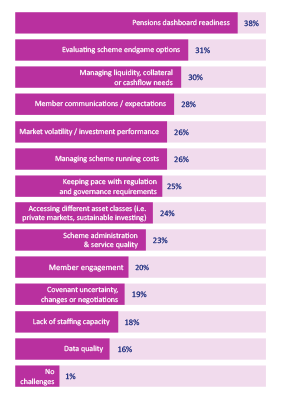
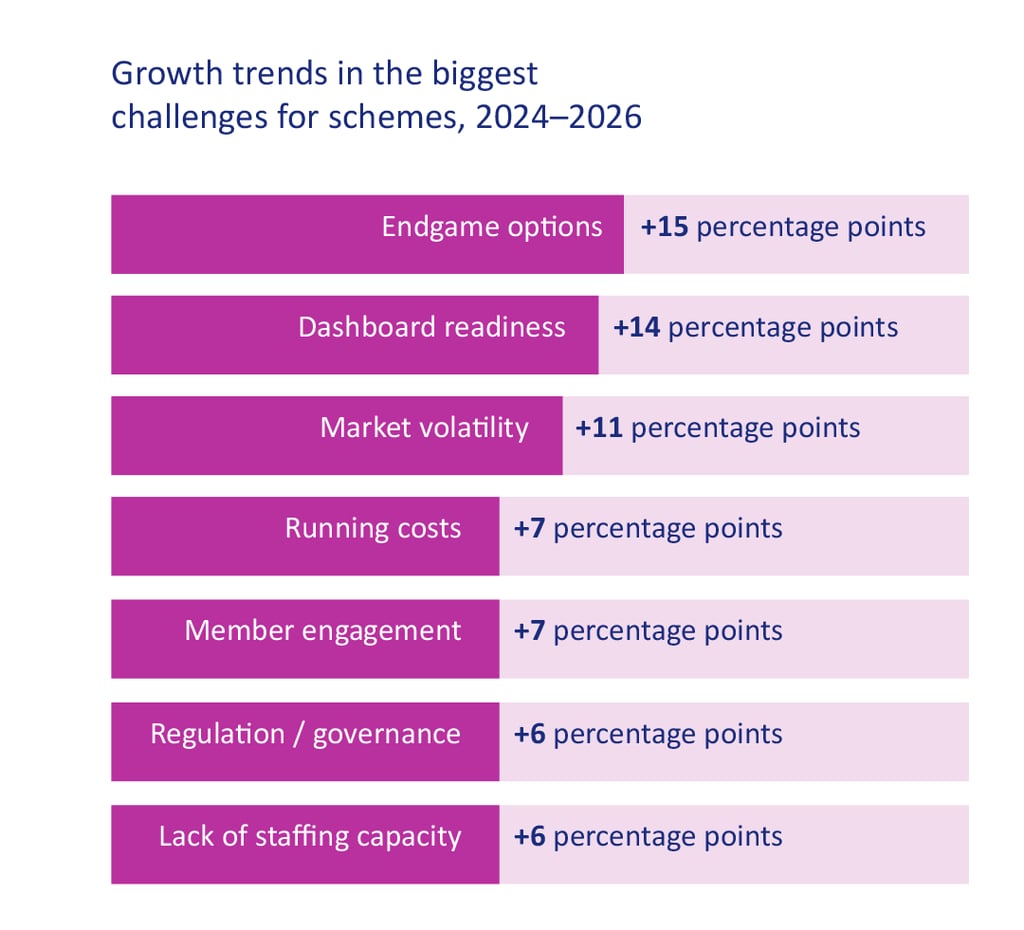
Today’s trustees are managing a broad range of competing priorities. Dashboard readiness understandably poses the biggest challenge, but long-standing factors such as keeping pace with regulation and governance, managing running costs, market conditions and member engagement have all become more prominent since 2024 (see Chart 2). The fastest-rising priority remains endgame planning, with 31% of trustees citing it as a major challenge, against just 16% in 2024.
The most striking finding is not that endgame planning has risen up the trustee agenda, but that, over the last two years, it has done so alongside a multitude of additional factors.
Over the past few years, trustee attention has shifted from closing DB scheme deficits to improved funding positions, de-risking and preparing for eventual endgame. As funding positions strengthened and more schemes moved closer to their preferred destination, strategic discussions around scheme endgames have naturally become more prominent. However, this has not lessened the practical demands of running a pension scheme and, in fact, has increased the need to focus attention on some key areas.
Chart 1. What are likely to be the biggest challenges for your scheme(s) over the next 12 months? (Select up to 5)
Trustees are trying to think strategically while managing the return of day-to-day complexity
Chart 2. Growth trends in the biggest challenges for schemes, 2024–2026
Not every challenge has become more significant. Concerns around accessing different asset classes and data quality have declined modestly since 2024, suggesting that progress has been made in areas that previously required greater trustee focus.
The more important story, however, is the cumulative effect. The findings suggest that trustees are no longer dealing with a single dominant challenge. Instead, they are balancing strategic decision-making alongside an increasing number of operational and governance demands.
Endgame planning is not replacing other priorities, but being pursued alongside them. Trustees are increasingly focused on long-term strategy, but they must do so within a broader agenda that includes regulation, managing liquidity, member communications, market volatility and cost control.
31%
16%
Endgame planning is seen as a key challenge by 31% of trustees (against just 16% in 2024) - but dashboard readiness, a regulatory requirement, is most pressing, at 38%.
Operational pressures are shaping strategic decisions
These operational demands are not simply background noise. They are influencing the way in which schemes prioritise and execute strategic decisions.
Take, for example, dashboard preparation. For many schemes, work to meet regulatory deadlines and connection requirements is currently consuming significant trustee and administrative resource. Combined with an expanding list of priorities, meeting these demands may divert attention from other strategic activity, such as moving administration providers, pursuing consolidation opportunities or progressing towards an endgame transaction.
Schemes that are pursuing buy-out or other endgame solutions face substantial implementation work of their own. Data quality improvements, benefit assurance exercises, administration readiness and transaction preparation all require significant time, resource and adviser support which can incur additional fees.
The implication is that many trustee boards are finding it challenging to access the capacity they need to execute their preferred direction of travel for their schemes. As trustee boards become increasingly stretched, the practicality of implementation can become almost as important as the strategy itself.
Different schemes are experiencing
different pressures
While complexity is rising across the market, the nature of those pressures varies by scheme size.
Trustees overseeing schemes with less than £1bn in assets are most likely to identify evaluating scheme endgame options as a key challenge, with pensions dashboard readiness also ranking highly. Managing running costs, member communications and staffing capacity also feature strongly, suggesting smaller schemes are balancing strategic endgame decisions with immediate resource and operational pressures. By contrast, larger schemes are more focused on pensions dashboard readiness and managing liquidity, collateral or cashflow needs, alongside administration, governance, member communications and investment-related demands.
These findings suggest that complexity is not being experienced uniformly across the market. Smaller schemes appear to be balancing resourcing pressures with decisions about their endgame strategy, while larger schemes are increasingly occupied with the operational demands that come with scale.
>£1bn
<£1bn
Endgame evaluation
Dashboard readiness
Running costs
Member communications
Staffing capacity
Dashboard readiness
Liquidity & cashflow management
Regulation / governance
Market volatility
Member communications
Administration quality
The challenge is capacity, not intent
Taken together, the findings suggest that endgame has become a mainstream strategic consideration and is firmly embedded in trustee thinking.
But trustees are trying to progress complex strategic decisions while managing other significant demands. As agendas become more crowded, the time and resource available to evaluate and execute major decisions is inevitably stretched. Looking ahead, the findings raise broader questions about whether traditional governance models will remain sufficient as schemes continue to face growing operational and strategic demands.
This may help to explain why solutions, such as consolidation, that reduce complexity, improve governance efficiency or provide access to greater scale are attracting growing interest3. For many schemes, the appeal of consolidation options is about making their endgame journey more manageable.
"For a number of years, the industry conversation was dominated by funding, de-risking and endgame planning. Those priorities have not gone away, but there is now greater recognition of the growing practical realities trustees face in overseeing a pension scheme. Dashboards, governance, data, administration and implementation projects all compete for the same time and resource."
Nicolas Clapp, Chief Commercial Officer
For professional use only. Not for individual/member use. This document is for information purposes only and does not constitute financial or legal advice. Trustees and sponsors should seek independent advice tailored to their circumstances.
TPT Retirement Solutions Limited. Registered in England and Wales under company number 09639961. Registered office: Aire Park, 5th Floor, 3 South Brook Street, Leeds LS10 1FT.

Key takeaway
The challenge facing many trustee boards is finding the time, resource and governance capacity to evaluate and execute the potential endgame options that are on the table. As complexity increases, simplicity and ease of implementation are becoming increasingly important factors in decision-making. Trustees are not only considering which endgame route offers the best strategic outcome, but also which can be progressed efficiently within the practical constraints of trustee time, governance budgets, adviser support and operational capacity.



TPT is a consolidation specialist. Our pension solutions are designed to cut through complexity to deliver greater choice and flexibility for trustees and employers, and the potential for improved outcomes for members.
Whether you're exploring consolidation, buy-out preparation or long-term run-on, TPT offers a range of award-winning solutions to help manage governance requirements, improve operational efficiency and help control costs. Our defined benefit solutions include DB Master Trust, DB Multi-Trust, Fiduciary Management and we’re developing a run-on superfund proposition.*
Get in touch
*Subject to regulatory approval
Contact one of our consolidation experts – we’re always happy to talk.
Insight Report 4:
Coming Soon
Insight report 2:
The Cost of Complexity
Insight report 1:
The Capacity Challenge
For professional use only. Not for individual/member use. This document is for information purposes only and does not constitute financial or legal advice. Trustees and sponsors should seek independent advice tailored to their circumstances.
TPT Retirement Solutions Limited. Registered in England and Wales under company number 09639961. Registered office: Aire Park, 5th Floor, 3 South Brook Street, Leeds LS10 1FT.
Introduction
2 Research carried out between 28th May and 4th June 2026. More information about the survey can be found in the About this Research section.