The Cost of Complexity
Understanding the pressures
behind DB scheme costs
Insight Report 2:
Introduction
Cost pressures have long been part of the defined benefit (DB) landscape, but the findings from the TPT DB Trustee Pulse 2026 suggest their role may be evolving.
Rather than being driven by a single issue, the trustees surveyed indicate that cost pressures are increasingly reflecting the cumulative demands of governance, regulation, data, administration and implementation. The findings suggest that cost pressures may not be experienced uniformly, with larger and more complex schemes reporting the sharpest increases.
This second insight report from the TPT DB Trustee Pulse 20261 examines what is driving scheme running costs, why those pressures are not being felt evenly, and how cost is becoming a strategic consideration for trustee boards.
Future reports from this year’s Pulse will focus separately on endgame options and superfunds, and investment priorities and asset allocation.
Read our previous report on The Capacity Challenge here.
Cost has long been part of the DB landscape, but the findings suggest its role may be evolving. Rather than being driven by a single issue, cost pressures are increasingly reflecting the cumulative demands of governance, regulation and operational delivery.
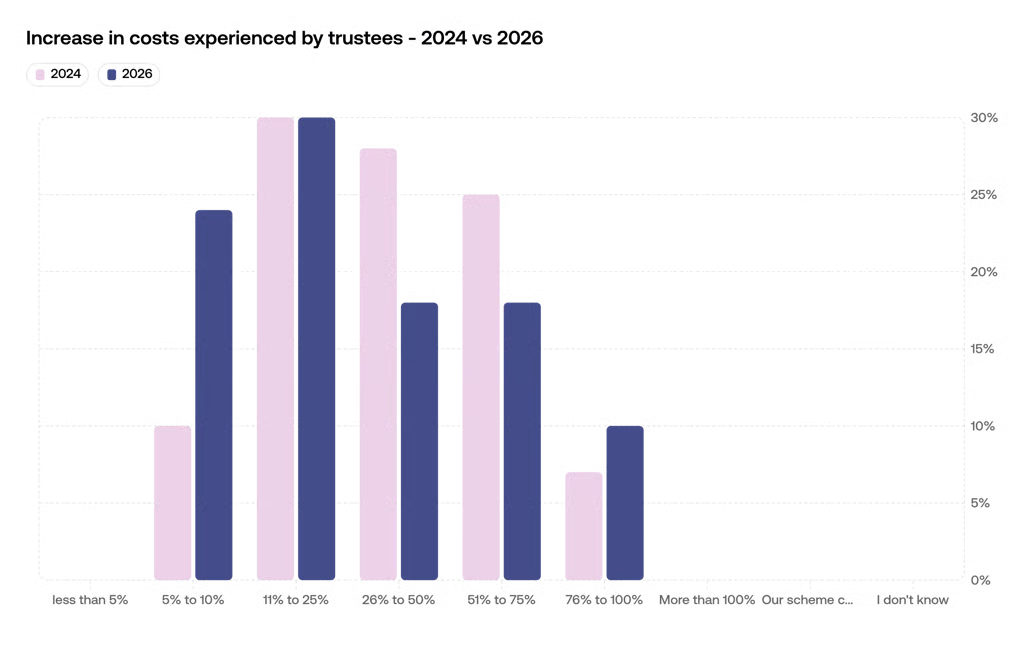
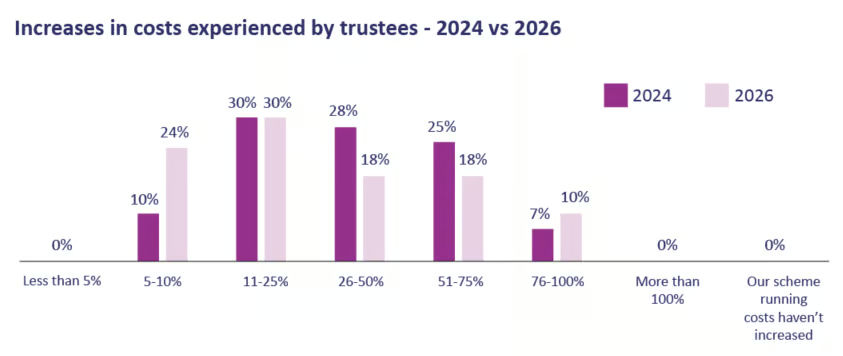
Trustees surveyed report average scheme running cost increases of 34% over the past 12 months. While this is slightly below the 37% reported in 2024, the findings suggest that cost pressures remain significant for many respondents.
Cost increases alone do not determine value. Two schemes may experience similar rises in expenditure yet derive very different benefits from that investment. Effective decision-making is important to help ensure that rising costs translate into improved outcomes.
Chart 1. By how much have your scheme's running costs increased in the past 12 months?
Cost pressures remain significant
Interestingly, no single category stands out as the primary driver. Instead, trustees point to rising costs across the board. Technology and data services rank among the most significant sources of cost increases despite declining as immediate challenges since 2024.
This may suggest that some schemes are successfully addressing these priorities, albeit with a significant investment of time and resources.
This supports the earlier suggestion that schemes are devoting increased resource to governance, compliance, operational readiness and regulatory requirements. It also indicates that rising costs may reflect the increasing complexity of running a pension scheme, rather than a single market-wide issue.
Many of the areas identified are closely linked to the delivery of scheme strategy. Dashboard preparation, GMP equalisation, data improvement projects, governance requirements and implementation work associated with the new funding regime all call for specialist support and additional resource. At the same time, schemes preparing for buy-out, run-on or other endgame destinations may be investing in data quality, benefit assurance and administration readiness before they can successfully transact.
Trustees are no longer simply managing the costs of running a scheme, but often the costs of implementation and preparation, too.
What's driving costs today?
The research suggests that today’s cost pressures are broad-based rather than concentrated in a single area.
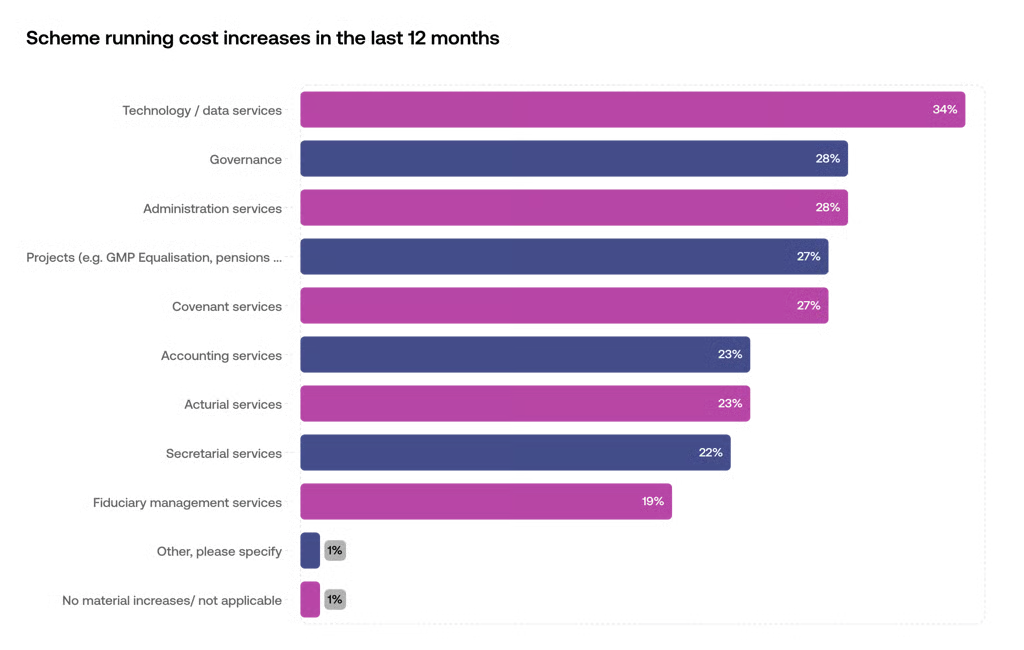
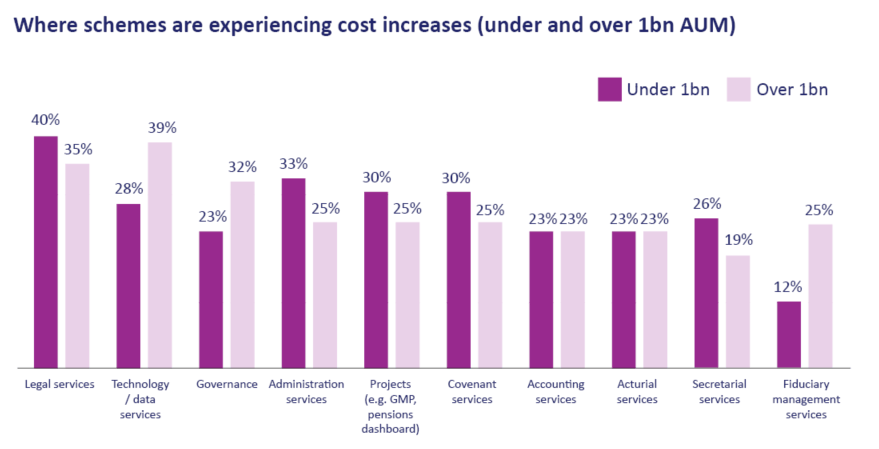
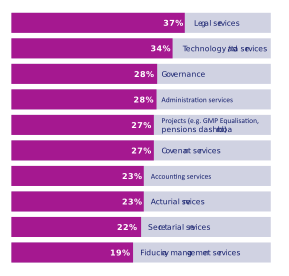
The trustees surveyed most commonly identify legal services, technology and data services, governance activities and administration services as the areas where costs have increased most significantly over the past 12 months. Trustees also point to costs associated with the growing focus on endgame planning and the work involved in pensions dashboard.
Legal services, technology and data services, governance and administration are among the most frequently cited drivers of cost increases over the past 12 months.
Chart 2. Which scheme running costs have seen the biggest increase in absolute terms, in the past 12 months? (Select up to 3)
Cost pressures are not being felt evenly
While cost pressures remain widespread, the results show that the burden is felt differently across the market.
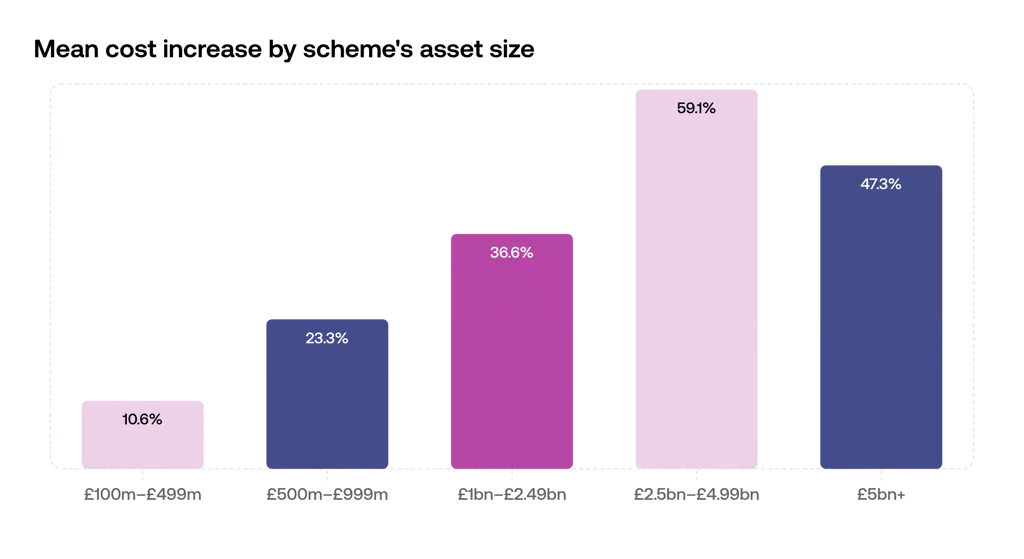
The clearest distinction emerges when schemes are segmented by assets under management (AUM). Contrary to expectations, Trustees overseeing schemes with more than £1bn AUM reported more substantial annual increases in running costs than those responsible for smaller schemes.
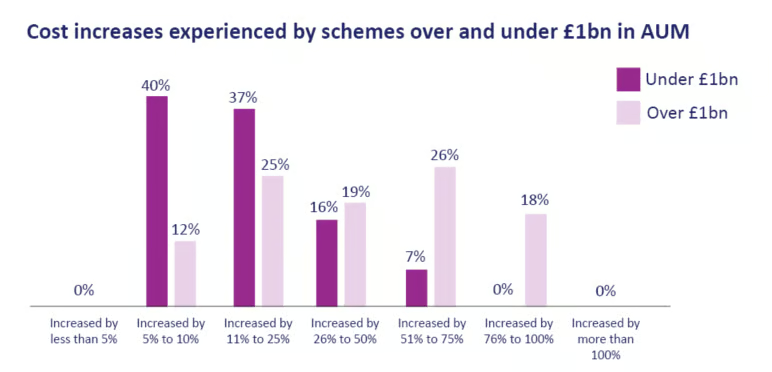
Almost half (44%) of the trustees overseeing schemes with more than £1bn AUM report increases of more than 50%, compared to just 7% of trustees overseeing schemes below that threshold.
Similarly, none of the trustees overseeing schemes with less than £1bn AUM report cost increases of 76% to 100%, whereas almost one in five (18%) trustees overseeing schemes with £1bn or more in AUM fall into that category.
While schemes of all sizes are experiencing rising costs, the most significant increases are concentrated among larger, and typically more complex, arrangements. These schemes may be more likely to be undertaking major projects, preparing for endgame transactions or managing more extensive governance and operational requirements.
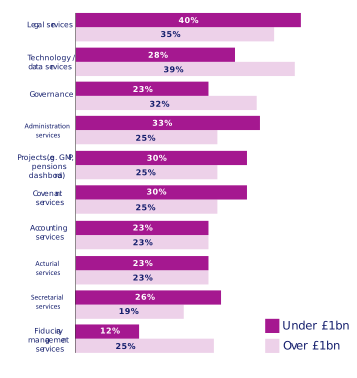
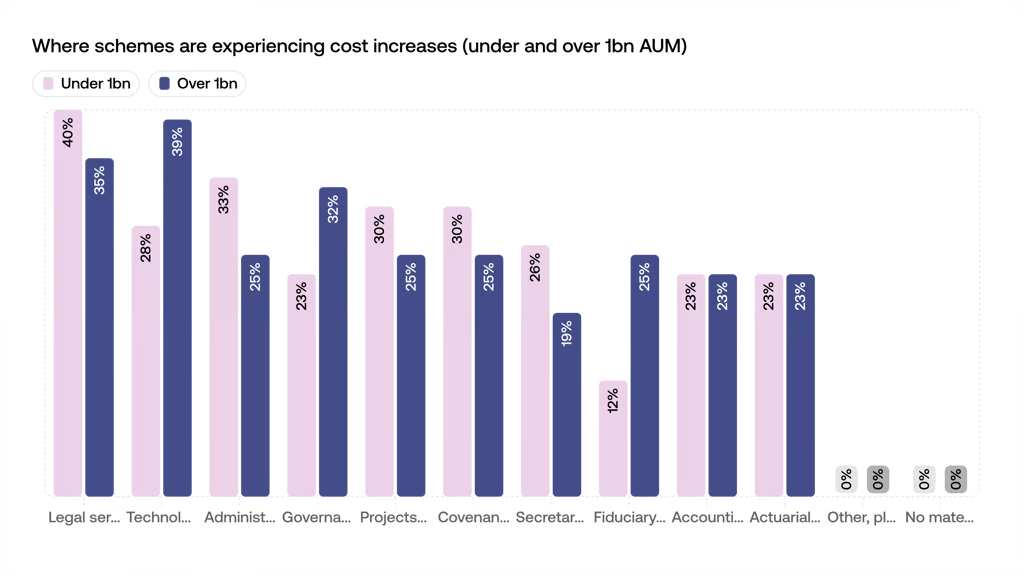
At the same time, smaller schemes are more likely to feel cost pressure from the practical realities of running a scheme, with legal, administration, projects and covenant continuing to consume budget. While the scale of cost increases may be lower, smaller schemes often have fewer resources and less opportunity to spread fixed operational costs, meaning even modest increases can have a more pronounced impact on trustee decision-making.
Chart 3. By how much has your scheme's running costs increased in the past 12 months? Comparison of schemes over and under £1bn AUM
Chart 4. Which scheme running costs have seen the biggest increase in absolute terms, in the past 12 months? (Select up to 3) Comparison between schemes over and under £1bn AUM
Cost is becoming a strategic consideration
The findings suggest that cost is no longer simply a budgetary issue. Rising expenditure can absorb trustee time, management focus and adviser resource, with the potential to detract from other strategic or more pressing priorities.
The areas experiencing the greatest cost increases (legal support, governance, administration, technology and data) are all fundamental to delivering good governance and meeting regulatory expectations. This could suggest that efforts to maintain high standards are becoming increasingly resource-intensive for some schemes.
Cost also needs to be considered in the context of long-term scheme strategy. Schemes preparing for a risk transfer may need to invest in data quality, benefit assurance, administration readiness and transaction preparation before they can successfully progress.
The research findings may also help to explain why consolidation and scale continue to hold the market’s attention. While endgame decisions will always depend on a range of factors. Some trustees may consider whether solutions that offer governance support, operational efficiencies or economies of scale could help address increasing complexity and cost pressures.

Key takeaway
Cost pressures remain a significant feature of the DB landscape. The survey findings suggest that governance, regulation and implementation activities are among the factors contributing to increasing costs for many schemes. The findings also indicate that trustees continue to consider a range of approaches to managing operational complexity, alongside traditional funding and endgame objectives.



TPT is a consolidation specialist. Our pension solutions are designed to cut through complexity to deliver greater choice and flexibility for trustees and employers, and the potential for improved outcomes for members.
Whether you're exploring consolidation, buy-out preparation or long-term run-on, TPT offers a range of award-winning solutions to help manage governance requirements, improve operational efficiency and help control costs. Our defined benefit solutions include DB Master Trust, DB Multi-Trust, Fiduciary Management and we’re developing a run-on superfund proposition.*
Get in touch
*Subject to regulatory approval
For professional use only. Not for individual/member use. This document is for information purposes only and does not constitute financial or legal advice. Trustees and sponsors should seek independent advice tailored to their circumstances.
TPT Retirement Solutions Limited. Registered in England and Wales under company number 09639961. Registered office: Aire Park, 5th Floor, 3 South Brook Street, Leeds LS10 1FT.
of trustees overseeing schemes with £1bn+ AUM report running cost increases of more than 50%, compared with just 7% of trustees overseeing smaller schemes.
44%
Insight Report 4:
Coming Soon
Insight report 1:
The Capacity Challenge
Insight report 2:
The Cost Of Complexity
1 Research carried out between 28th May and 4th June 2026. More information about the survey can be found in the About this Research section.
Scheme running cost increases in the last 12 months
Increases in costs experienced by trustees - 2024 vs 2026
Cost increases experienced by schemes over and under £1bn in AUM
Where schemes are experiencing cost increases (under and over 1bn AUM)