
The Superfund Timing Challenge

Are schemes considering superfunds early enough?
Insight Report 3:
Introduction
DB superfunds have become firmly established within the endgame conversation.
The latest findings from the TPT DB Trustee Pulse 2026 suggest that awareness is almost universal amongst the trustees surveyed, with more than half of them saying they are actively considering a superfund transaction, and most expecting superfunds to become more common across the UK market over the next two years.
Taken together, these findings suggest the conversation has moved beyond awareness and into active evaluation. Trustees are no longer asking what a superfund is, but increasingly, when they should assess them as an option and where one may fit within their scheme's endgame strategy.
The research also raises a broader question about timing. If a superfund is to be a realistic endgame option, should schemes be evaluating it earlier in their journey rather than waiting until they are close to transacting to buy-out? While the research does not answer this directly, it does suggest that funding readiness remains a key consideration and that trustees are increasingly focused on understanding where superfunds fit within the wider endgame landscape.
Superfunds are now part of mainstream endgame planning
Almost all trustees surveyed say they are familiar with superfunds, while 95% believe their trustee board has a complete understanding of the endgame options available to them.
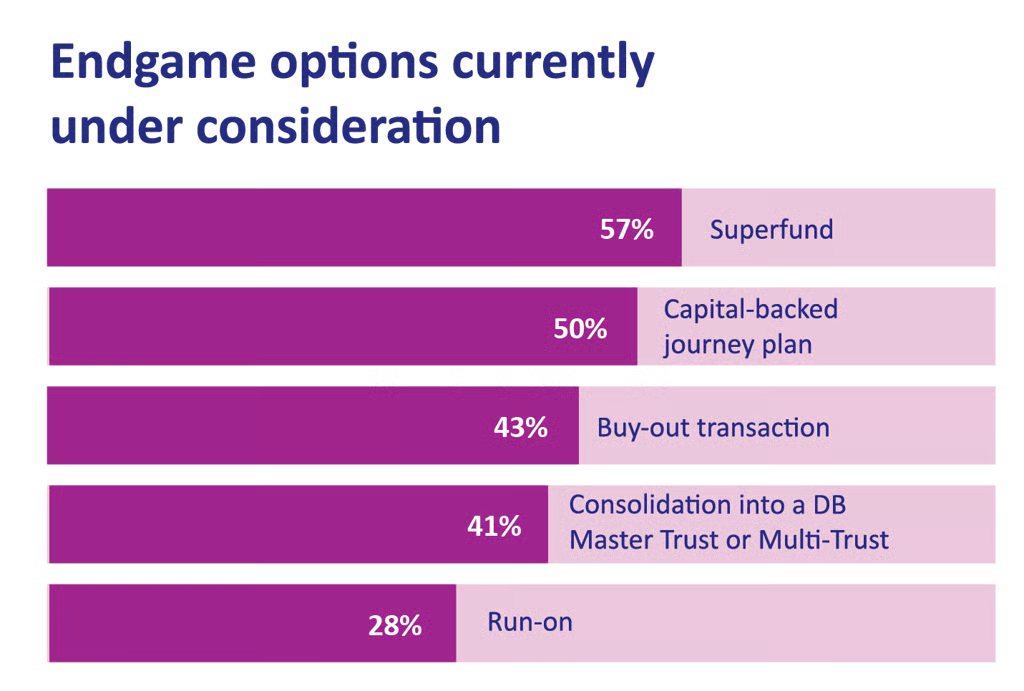
More importantly, superfunds appear to have progressed beyond simple awareness and into active endgame planning. When asked which endgame options they are currently considering, superfunds emerge as the most commonly selected option, ahead of buy-out, capital-backed journey plans, DB master trust/multi-trust consolidation and run-on.
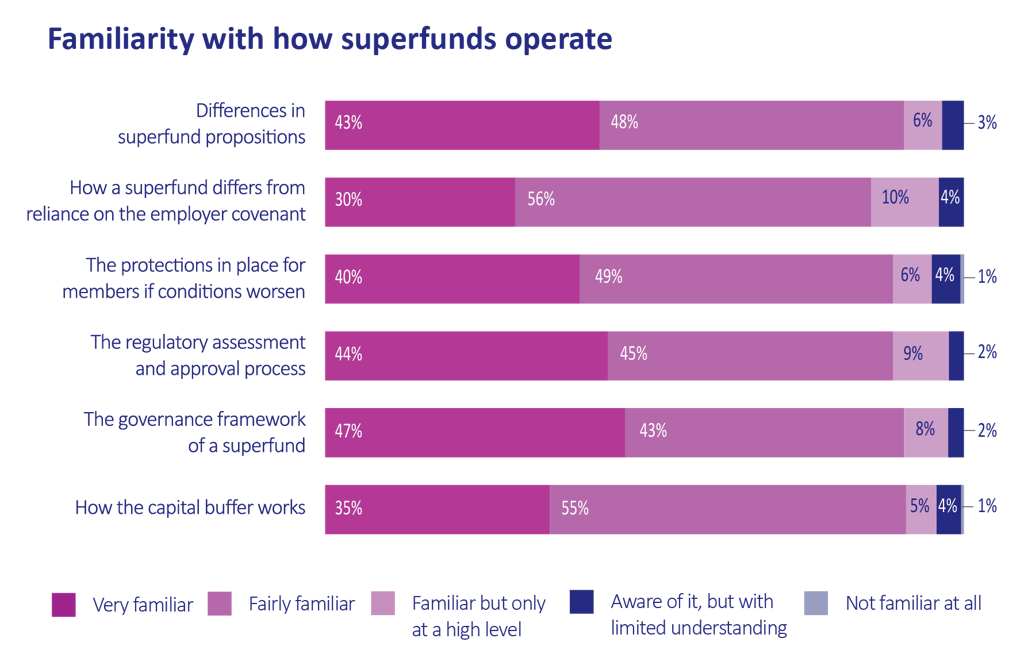
Chart 1: What endgame options are you currently considering for your scheme/s? (Select all that apply)
Chart 2: How familiar are you with the following aspects of how different superfund propositions are expected to operate in practice?
This suggests that superfunds are no longer viewed as a specialist or niche solution. They are becoming part of mainstream endgame discussions and are being evaluated alongside more established destinations.
However, familiarity is not necessarily the same as detailed evaluation. While trustees report high levels of awareness, familiarity is lower in some of the practical areas that are likely to become important when assessing whether a superfund is appropriate for a particular scheme, including capital structures, member protections and covenant comparisons.
While there are modest differences between topics, these are not particularly pronounced. Trustees are slightly more likely to describe themselves as very familiar with governance frameworks, regulatory assessment processes and the differences between superfund propositions than with capital buffers or how a superfund compares with reliance on the sponsoring employer covenant.
The findings do not suggest a lack of familiarity. Rather, they may reflect where the market currently is. Trustees appear comfortable with the broad concept and regulatory framework of superfunds, while some of the more detailed questions around covenant comparisons, capital structures and member protections are likely to become increasingly important as schemes move from awareness into active evaluation of whether a superfund could form part of their endgame strategy.
The consideration question is inherently linked to a scheme's individual circumstances. Whether a scheme is actively considering a superfund will depend on factors such as funding level, covenant strength, maturity profile and strategic objectives. A scheme may therefore be considering a superfund because it is potentially relevant to its situation.
The attractiveness question is different. It asks trustees to form a broader view of an endgame option rather than assess whether it is suitable for their own scheme. As a result, it is entirely possible for trustees to view a buy-out as highly attractive while simultaneously evaluating whether a superfund may be more relevant to their scheme's specific circumstances.
The findings therefore suggest that trustees are not simply judging whether they like or dislike superfunds. Instead, they appear to be assessing where superfunds fit within a wider range of endgame options.
One of the more interesting findings in the research is the distinction between consideration and attractiveness.
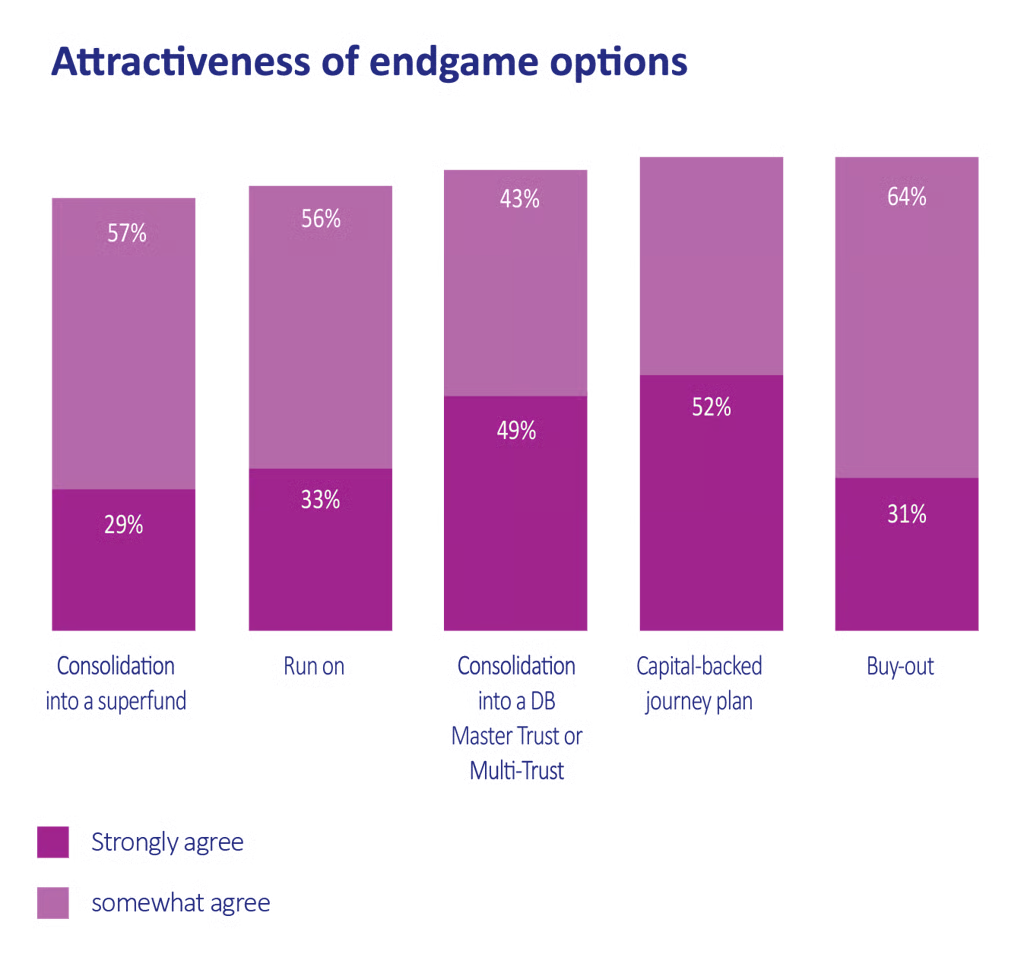
More trustees say they are actively considering a superfund than any other endgame option. Yet superfunds are not rated as attractively as buy-out, capital-backed journey plans or DB master trust/multi-trust consolidation when trustees are asked to assess different endgame solutions more generally.
Consideration and suitability are closely linked
Attractiveness captures overall appeal, whereas consideration reflects a belief that a Superfund could be a suitable and relevant solution for a scheme's specific circumstances.
Chart 3: To what extent do you agree or disagree that each of the following is attractive as an end game solution?
The biggest question may be timing
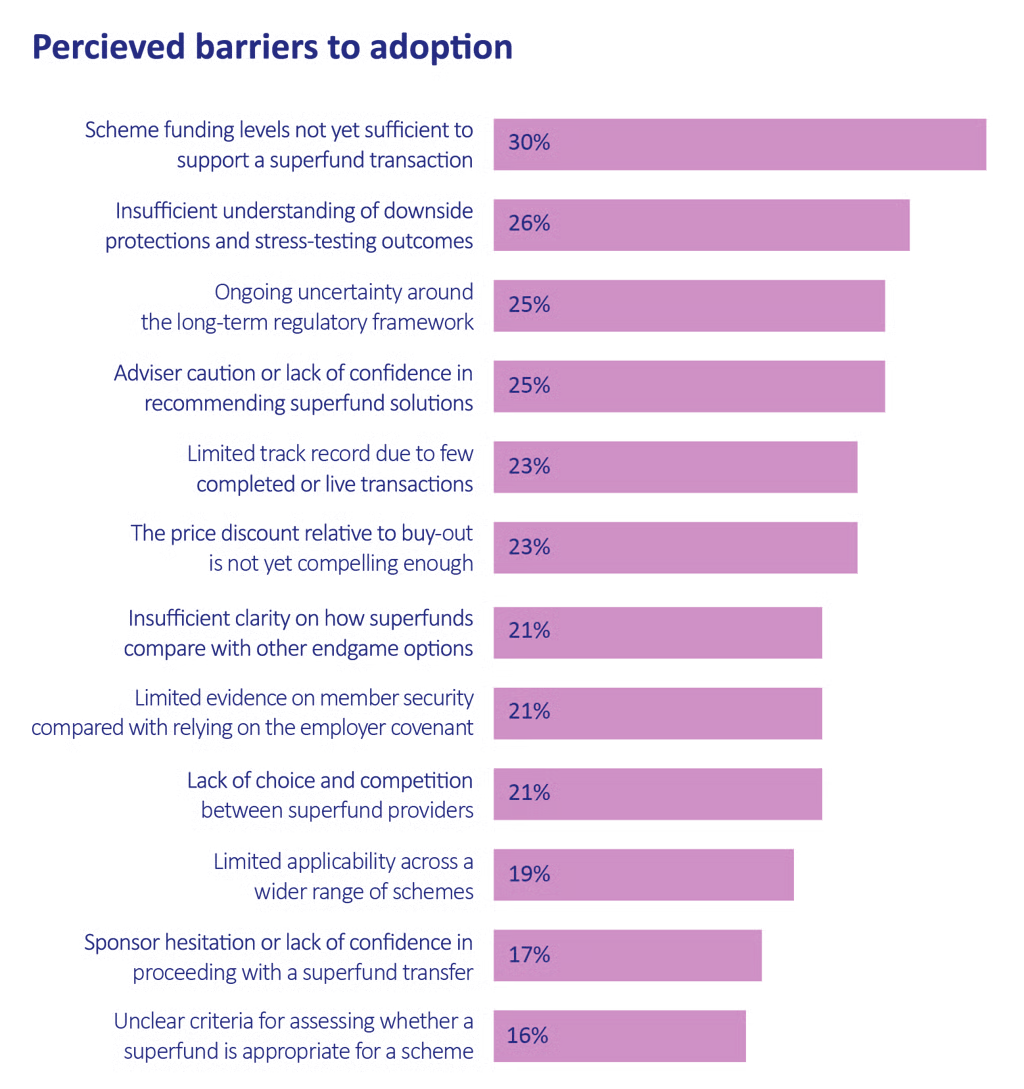
The survey shows that scheme funding readiness is the most commonly cited barrier to wider superfund adoption. Trustees also identify a range of other considerations, including downside protections, regulatory certainty, adviser confidence and track record.
Importantly, no single factor dominates the results. The findings suggest trustees are weighing up multiple considerations when determining whether a superfund could be appropriate for their scheme.
This raises an interesting question.
If funding readiness is the most cited barrier, should the assessment of a potential superfund journey begin before a scheme reaches the point at which a transaction becomes achievable?
As with any endgame destination, progressing towards a superfund may require preparatory work around funding, data, benefits, governance and adviser support. While schemes may ultimately choose a different route, understanding where a superfund fits within the broader strategy may need to happen well before a final transaction decision is required.
The findings suggest that many schemes are now considering superfunds. The next challenge may be ensuring that the evaluation takes place early enough to give trustees the widest possible range of options when key strategic decisions are made.
Chart 4. What do you see as the biggest barriers to adoption of DB superfunds in the UK market? (Select up to 3)
Early, effective evaluation steps:
1
Ask your adviser to track your funding level and notify when a transaction is approaching affordability, be that superfund, buy-out or an alternative.
2
Agree principles for considering endgame options, including one preferred route, with potential to adapt if scheme circumstances change.
3
Move the scheme towards endgame readiness (benefit clarity, data accuracy, appropriate investment strategy) so that you can take advantage of any market opportunities with speedy execution.
"The findings suggest that the key question is no longer whether superfunds should be considered, but when. Schemes that start evaluating potential endgame destinations earlier may be better placed to act when opportunities arise and retain the widest range of options available to them."
Steve Collins, Head of Superfund
Looking ahead
Trustees are broadly positive about the future of the market.
Ninety-five per cent believe superfund transactions will become more common over the next two years, while 93% say their own scheme would be likely to seriously consider a superfund as an endgame option.
These findings suggest that trustees increasingly view superfunds as an established part of endgame planning. However, the research also highlights that suitability will inevitably vary between schemes. Not every scheme will pursue a superfund transaction, nor should every scheme. Endgame decisions remain highly dependent on individual circumstances.
As the market develops, the debate may therefore become more about readiness: understanding which endgame options are available, under what circumstances they are appropriate, and at what point should those discussions begin.
Chart 5 & 6: Looking to the next two years, how likely or unlikely do you think the above statements are?
Key takeaway
The research suggests that superfunds are beginning to move into mainstream endgame discussions. Trustees are familiar with them, many are actively considering them, and most expect the market to continue growing.
But perhaps the most important question emerging from the findings is not whether trustees are considering superfunds, but when.
If superfunds are to form part of a scheme's endgame strategy, the evaluation process may need to begin long before a scheme reaches the point at which a transaction becomes feasible. The findings suggest that, for some schemes, the opportunity may lie not simply in considering superfunds, but in considering them early enough.
In doing so, stakeholders are better placed to:
Trustees
Reach a secure endgame outcome at an earlier stage
Remove future covenant reliance in uncertain economic conditions
Companies
Remove pensions risk from the balance sheet earlier
Deliver a pensions solution at lower or even nil contribution requirement
Deliver a secure outcome for pension schemes, fulfilling commitment



Get in touch
*Subject to regulatory approval
For professional use only. Not for individual/member use. This document is for information purposes only and does not constitute financial or legal advice. Trustees and sponsors should seek independent advice tailored to their circumstances.
TPT Retirement Solutions Limited. Registered in England and Wales under company number 09639961. Registered office: Aire Park, 5th Floor, 3 South Brook Street, Leeds LS10 1FT.
Insight Report 4:
Coming Soon
INSIGHT REPORT 3:
The Superfund Timing Challenge